Policy Admin Formulas
Product formulas, part of the Product Factory, help you process relevant product origination inputs (such as income, age, assets, risk class, etc.) to calculate desired outputs (such as credit scores, interests, discounts, etc.). When designing a product, you can either reuse existing formulas or create new formulas based on your requirements.
Product formulas leverage the power of Business Formulas to create complex product-centric computations using a simple sentence-based user interface. When writing a product formula, you just enter the formula expression, then specify the source of each attribute you used in that expression (either an input, data set, or another formula).
Business formulas are defined using the Formula Editor, where you write the formula's actual mathematical expressions and computations. In the editor, insert your formula expression based on a mathematical syntax comprised of the formula body and a call for calculation (the returned result). IntelliSense is available for quick selection of definitions and to provide additional information (such as properties and attributes) about the selected item.
In Product Admin Configuration, you can assign more than one pricing or underwriting formula to each product for MTAs and renewals. During processing, the system selects the right formula, gathers the needed data, and sends the result directly into the pricing or underwriting workflow.
The following formulas and calculations are used in the Policy Administration solution:
 Calculate MTA Premium Amounts
Calculate Premium Amounts According to the Prorata Type
The parameter contains 2 types of prorata:
-
Daily prorata as 1/365 from the annual premium amount of a contract;
-
Monthly prorata as 1/12 from the annual premium amount of a contract.
Parameter location: FintechOS Portal > Main Menu > Settings -> Insurance parameters
Parameter name: Prorata type
Parameter code: PRT
Parameter type and value: Option set = either Daily or Monthly
For the premium adjustments, either the daily prorata or the monthly prorata can be chosen.
Calculations MTA premium amounts
The following calculations are used for MTA premium amounts:
-
Policy Validity = number representing prorata periods (days or months) between policy begin date and policy end date.
Based on the prorata type, this returns either a number in days (for 1/365) or a number in months (for 1/12). For the 1/12 prorata, any started monthly period is considered a full month (e.g. for a policy validity of 2 months and 5 days, the policy validity used in this premium calculation is 3 months);
-
Uninsured Period = number representing prorata periods between MTA effective date and policy end date.
Based on the prorata type, this returns either a number in days (for 1/365) or a number in months (for 1/12). For the 1/12 prorata, any started monthly period is considered a full month (e.g. for a MTA validity of 1 months and 2 days, the uninsured period used in this premium calculation is 2 months);
-
New Premium Amount for the Validity Period = New Annual Premium Amount / Prorata of the policy * policy validity;
Prorata of the policy is 12 or 365 depending on the PRT parameter.
-
Before MTA Premium Amount = premium amount of the policy version on which the newly created MTA applies (includes impact from previously issued MTAs)
-
Before MTA Premium Amount for the Validity Period = Premium Amount for the Validity Period of the policy version on which the MTA was created;
-
Premium Amount Difference for the Validity Period = New Premium Amount for the Validity Period - Before MTA Premium Amount for the Validity Period;
-
Premium Amount Difference is premium Amount Difference for the Validity Period prorated to the uninsured period = premium Amount Difference for the Validity Period / policy Validity * uninsured Period;
-
New Final Premium Amount is The premium for the new policy version created by the MTA = Before MTA Premium Amount for the Validity Period + premium Amount Difference.
Example calculations
Let's take the following scenario:
-
Prorata = Monthly (12)
-
Policy validity = 8 months
-
Policy premium = 800
-
Premium Amount Validity Period = 800
After 3 months passed an MTA is issued, resulting an uninsured period of 5 months. The MTA gets a formula response for an annual premium of 2400.
This translates into a New Premium Amount for the Validity Period = 2400/12*8= 1600 (New Annual Premium is 2400, prorata is 12, and validity period is 8).
The Before MTA Premium Amount for the Validity Period is Premium Amount Validity Period because there are no changes (MTAs) until now = 800.
Premium Amount Difference for the Validity Period: New Premium Amount for the Validity Period - Before MTA Premium Amount for the Validity Period. This results to 1600 - 800 = 800.
Premium Amount Difference: Premium Amount Difference for the Validity Period / Validity * Uninsured Period. This results to 800 / 8 * 5 = 500.
New Final Premium Amount: Before MTA Premium Amount (the Premium Amount of the policy version on which the MTA was created) + Premium Amount Difference. This amounts to 800 + 500 = 1300.
2 more months pass and a new MTA is issued, resulting in an uninsured period of 3 months.
The Before MTA Premium Amount = 1300.
The Before MTA Premium Amount for the Validity Period is New Premium Amount for the Validity Period from previous policy version = 1600.
The MTA gets a formula response for a premium of 3600. This translates into a New Premium Amount for the Validity Period = 3600/12*8= 2400.
Premium Amount Difference for the Validity Period = 2400 - 1600 = 800.
Premium Amount Difference = 800 / 8* 3 = 300.
New Final Premium Amount = 1300 + 300 = 1600.
Calculate the Duration and Installments of Master Policies
In the Master Policy entity, the noOfValidityMonths attribute represents the number of calendar months between the begin date and the end date of the Master Policy. It is calculated as per below:
No of validity months = Master Policy Begin Date - Master Policy End Date
The number of installments of the Master Policy (noOfInstallments attribute, numeric type) is calculated based on the attributes: number of validity months (calculated above) and payment frequency of the Master Policy.
| Payment frequency | No of installments when v>-12 months | 6<=v<12 months | v<6 months |
|---|---|---|---|
| annually | roundup(v/12;0) | N/A | N/A |
| semi-annually |
roundup(v/6;0) |
roundup(v/6;0) | N/A |
| quarterly | roundup(v/3;0) | roundup(v/3;0) | roundup(v/3;0) |
| monthly | v | v | v |
Where:
-
v = The number of validity months of the Master Policy (noOfValidityMonths);
-
N/A = The system does not allow this combination.
Configure Formula Mappings for Insurance Products
You can use complex insurance formulas to calculate premiums for quotes and policies or underwriting rules. Formulas, once included in the product definition, have to be fed with data at the customer journey level. The calculated result is later consumed within customer journeys; the resulting applicable rate can be fed into policy context.
Policy Administration consumes insurance formulas included in the product definition. When using a formula associated to an insurance product within a policy, you must specify the formula mapping, that is the input data to be used for the formula in the context of Policy Administration.
To configure a product's formula mappings against attributes from the data model:
-
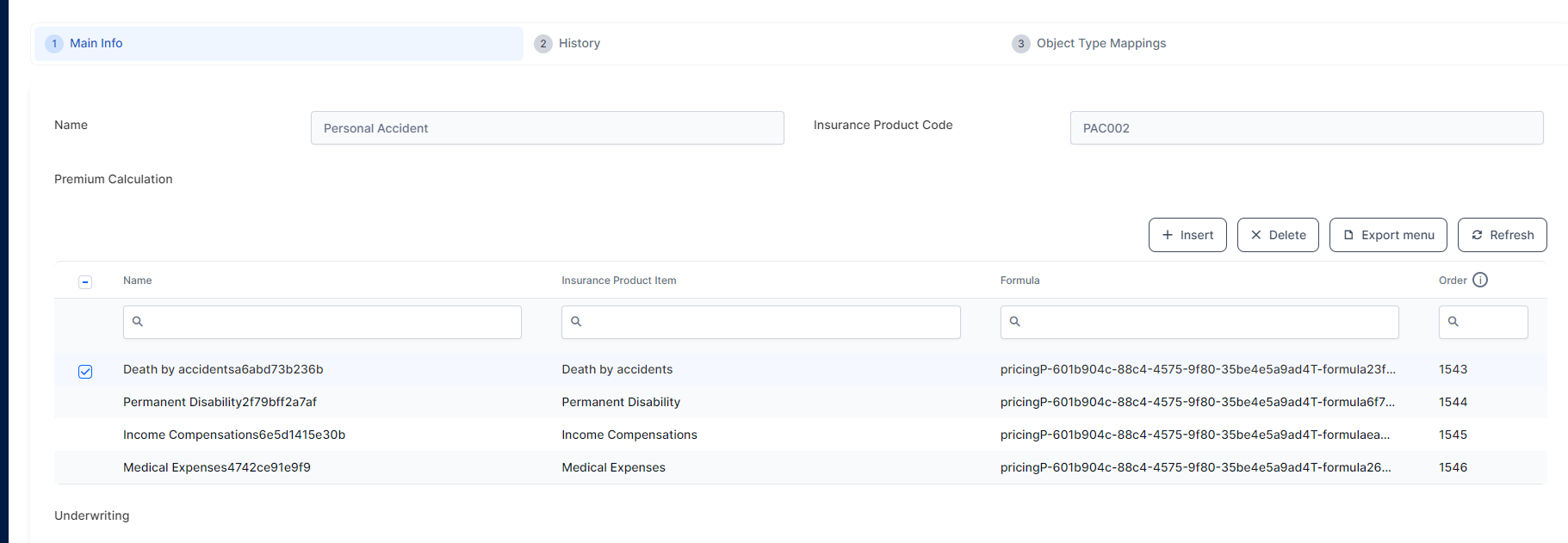
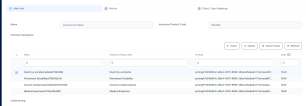
In FintechOS Studio, navigate to the Legacy Product Factory > Product Configurator > Product Servicing Configs menu item to open the Product Formulas Mappings page, displaying a list of all the insurance products with formulas which require mappings before being used in journeys.
-
Double-click the desired product to open its Product Formulas Mappings page.
-
If the selected insurance product has one or more associated formulas either for premium calculation or for underwriting, you can configure the formula mapping for each formula on the displayed Product Formulas Mappings page.
-
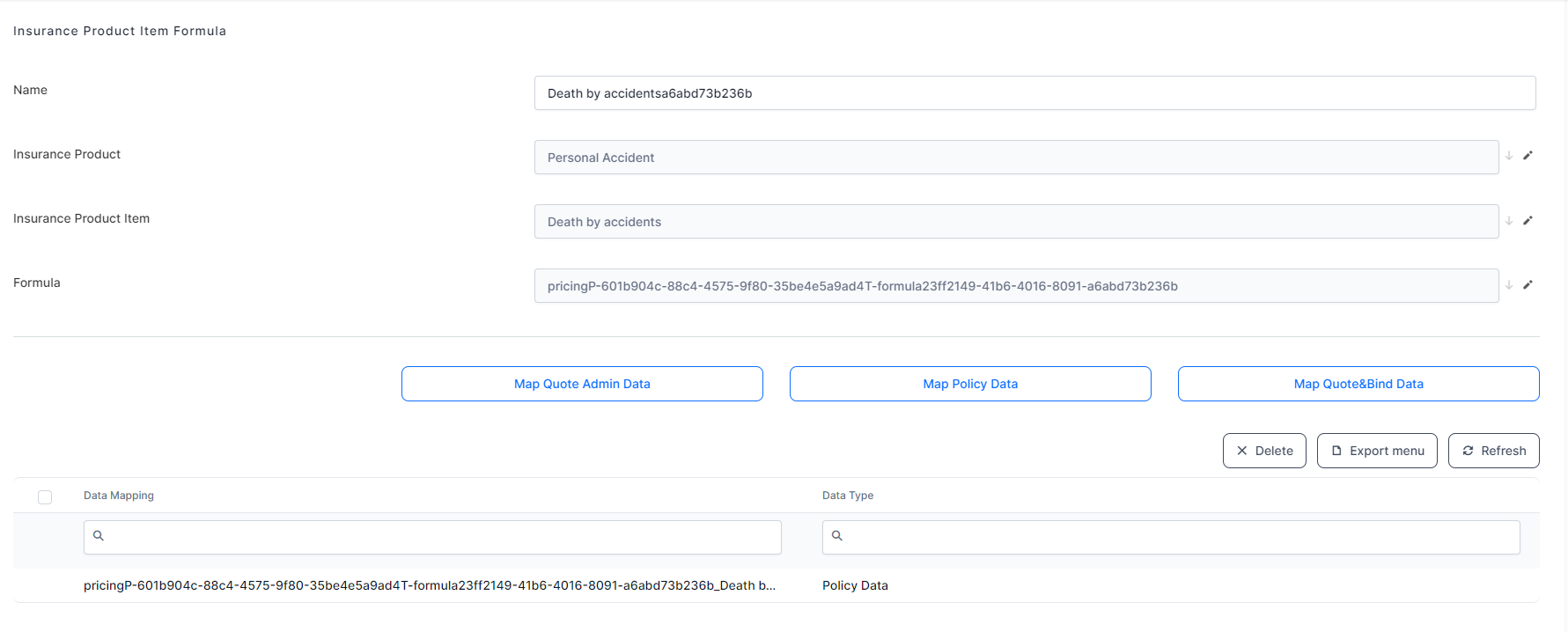
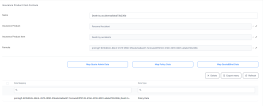
In the Premium Calculation or in the Underwriting grid, double click the desired formula to be mapped.
-
On the newly displayed Insurance Product Item Formula page for the selected formula, you can decide to map the formula against attributes from the data models of Quote Admin, Policy Admin, or Quote&Bind, clicking the respective buttons. In the context of Policy Administration, click Map Policy Data.
-
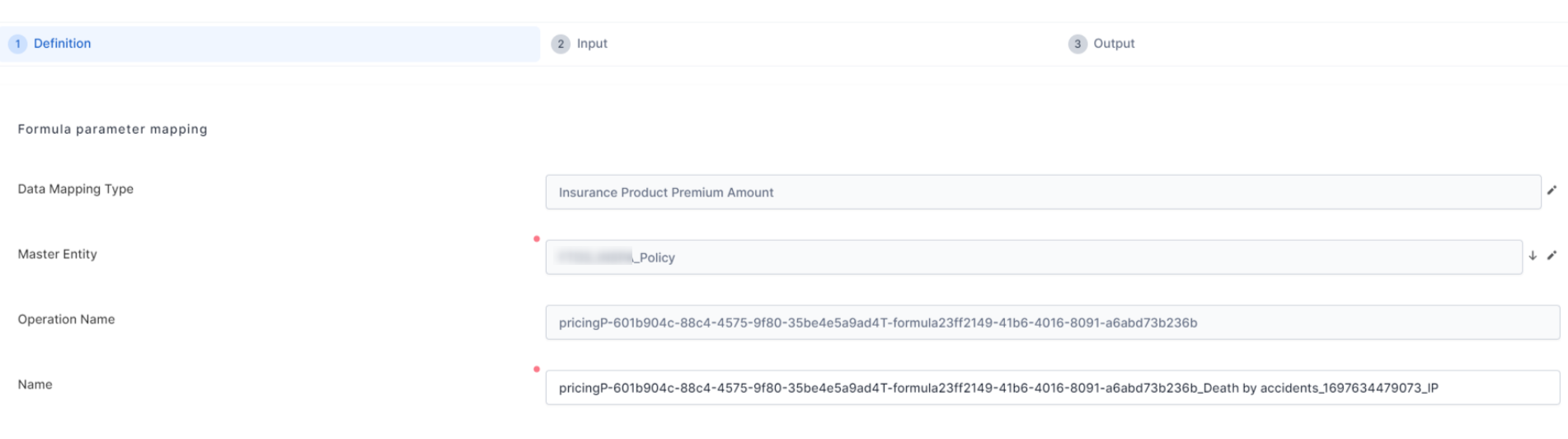
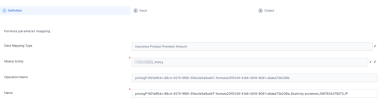
If there is no mapping defined yet, then on the newly displayed Formula Parameter Mapping page, click the down arrow next to the Master Entity field and select the entity on which the mapping should be applied.
-
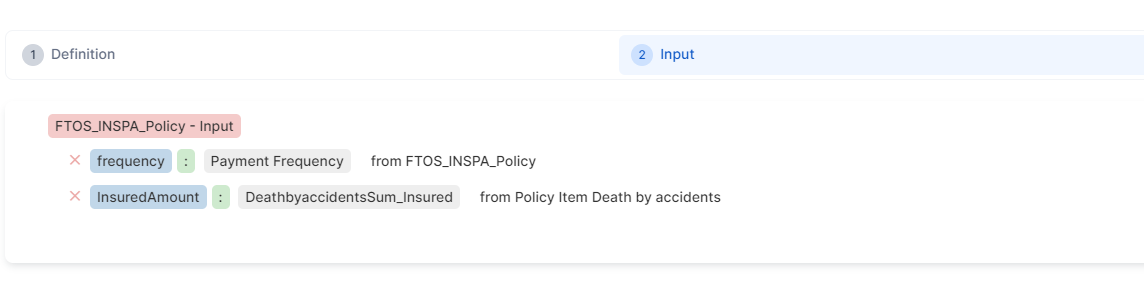
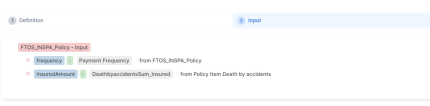
On the Input tab, continue with mapping the Input parameters of the formula with the required attributes of the selected master entity.
Read more about formula mappings here.
-
Click the Save and Close button.