Insurance Parameters
The Service Insurance solution contains a number of Parameters that, aside from the Flow Processors settings, also take a role in shaping the major behaviors executed by different FintechOS insurance modules - for example Policy Administration, Billing and Collection, Claims Management. Consequently, in order to answer your specific business needs, you use Service Insurance to change the values of the parameters managed by it and propagate your change into the behavior of your specific insurance module.
View Default Parameters
-
Open your FintechOS Portal and click the main menu at the top left corner. The main drop-down opens. From the drop-down choose Settings.
-
Inside the Settings menu, click Insurance Parameters. The Insurance Parameters list is displayed.
-
The parameters are arranged into modules. Expand one module to open its specific parameter.
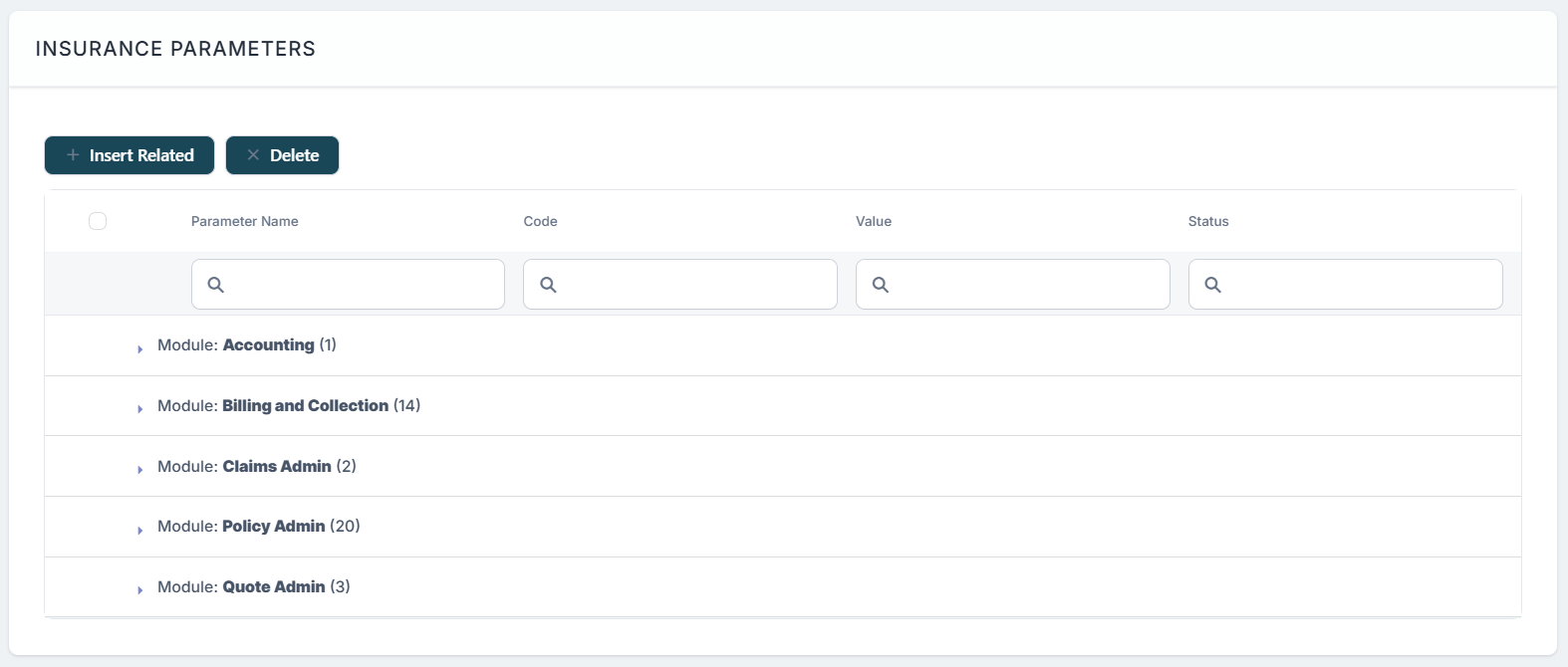
List of Default Parameters by Modules
 Accounting
| Category | Name | Code | Description | Default Value |
|---|---|---|---|---|
| Solution Activation | GLUsed | GLUsed |
Used to determine if the General Ledger (GL) entries should be generated or not. 1 -> Activate Operational Ledger Module. Accounting Registration will be done automatically; 0 -> Deactivate Operational Ledger Module; |
0 |
Billing and Collection
| Category | Name | Code | Description | Default Value |
|---|---|---|---|---|
| Broker collection | Broker Billing Statement Scope | BKSCOPE | Determines if the scope is Due Installments or Confirmed Payments For Due installments, the policies with payment type Broker collection and with due dates in the last month will be included in the invoices. Confirmed payments is not supported for now. | N/A |
| Broker Payment Allocation Criteria | BKPYMALC | Determines if the broker payments allocation should be made following the FIFO rule of by reference. | N/A | |
| Broker WO | BKWO | Determines if write offs are needed for the broker payments. No - no write off will be added Generic - insert a writeoff, considering product write off settings |
N/A | |
| Broker Billing Statement Generation | BKSGD | Day of the month when the invoices for the brokers should be generated. | N/A | |
| Direct Debit | DaysBeforeUKMandatesActivation | DBUKMA | This parameter sets the number of days allowed for receiving notifications (e.g. AUDDIS) about the cancellation of a mandate in Pending status. E.g. If this parameter is set to 5 days, the Draft mandate becomes Active in 5 days time, provided the mandate is not included in any imported AUDDIS file (containing a cancellation notification for it) by the 5th day (respectively by the last day of the period configured in the parameter). | 0 |
|
Invoice |
Installment Due Date | IDD | This parameter sets the number of days in the past, for which the installment are evaluated for the statement generation. | 7 |
| Statement Generation Number | SGN | Prefix and Padding of Invoice number(reference) | N/A | |
| StatementGenerationStatuses | SGS | The list of statuses for policy and master policy, for which the invoices need to be generated. | N/A | |
| No. of Days in Advance | SGDAY | This parameter sets the day for generating the statement (invoice) in advance with a number of days before the payment's due date. This parameter is set for all the invoices to be generated for the installments on a policy. The FTOS_PYMT_GenerateStatementJOB and FTOS_PYMT_GenerateStatementAPI that triggers the generation of the invoice are using this parameter. This is the default value, custom value can be set on product level. | 10 | |
| Notification | BillingNotification | BillingNotification | 1 -> Activate Billing and Collection notifications 0 -> Deactivate Billing and Collection notifications |
0 |
| NoOfDaysFollowUpInvoice | NDFI | The number of days used to evaluate the date in which the follow up invoice notification must be sent. | 3 | |
| Refund | No. of Days before Return | PRDAY | This parameter sets the number of days before automatically generating a Payment Return for a payment which is still in Unallocated status in the system. The value set in this parameter is used by the FTOS_PYMT_Payment_ReturnUnallocatedAmount scheduled job in order to trigger the payment return generation process. |
30 |
| Solution Activation | BillingUsed | BillingUsed | 1 -> Activate Billing and Collection Module 0 -> Deactivate Billing and Collection Module |
1 |
| Write Off | FTOS_ExchangeRateDefaultType | FTOS_ExchangeRateDefaultType | The default exchange rate type used in multiple process, like allocation, reinstatement or write off. Valid record in entity FTOS_CMB_ExchangeRateType. | BNR |
| Write Off | WO | This parameter sets the limit values for a Write-Off payment. This kind of payment is generated automatically by the system during the allocation of payments. This parameter can be set for RON and EUR currencies. | N/A |
Claims Admin
| Category | Name | Code | Description | Default Value |
|---|---|---|---|---|
| Claim | Major Loss | MLP | This parameter is used in order to set the minimum value for the major loss and its currency on a Claim. If multiple currencies are used, all of them must be defined in this parameter. | N/A |
| Solution Activation | ClaimUsed | ClaimUsed | 1 -> Activate Claims Admin Module 0 -> Deactivate Claims Admin Module| Default value: 1. The Cancellation process will search for claims only of this parameter value = 1 |
1 |
Policy Admin
| Category | Name | Code | Description | Default Value |
|---|---|---|---|---|
|
Cancellation |
Free Withdrawal Limit Date | FWLD | The parameter represents the number of days used in calculating the Free Withdrawal Limit Date for cancellation. | 14 |
| Policy automatically Withdraw | PWDAY | This parameter sets the Automatically Withdrawal Day of a policy after a number of days since the First Installment on that policy moved to Unpaid status. When the parameter is fulfilled, the policy is transitioned to Withdraw status. |
15 | |
| Notification | PolicyAdminNotification | PolicyAdminNotification | 1 ->Parameter that enables email notifications 0 -> Deactivate email notifications Default value: 1 |
1 |
| DaysBeforeExpirationGracePeriod | DBEGP | This parameter sets the number of days before the expiration of the grace period for an installment. Also, a lapsing notification is sent to a chosen address, within the number of days set through this parameter. | 1 | |
| Policy
|
Active policies status | APS | Active policy statuses, used in overlapping policies rule on policy generation. | N/A |
| Policy overlapping Insured product types | PO_IPT | The list contains the insurance product types for which the overlapping policy rule is verified. | ||
| Policy Suspension Duration (days) | PSDD | The default value used for insurance product policy suspension duration. | 1 | |
| Payment Grace Period (days) | PGP | This is the default value used to set the Payment Grace Period on product. | 1 | |
| Policy Alteration Settings | PAS | The default form for alteration Group | N/A | |
| Insurance Tax | IPT | Insurance premium tax percentage, used to calculate the value for TotalTaxes on policy and policy installments. | 3 | |
| No of days before renewal | NDBR | This parameter correlates the starting date of the Renewal process with a given number of days before the End Date of a policy. For example: it is required to start the Renewal process within 5 days before policy reaching its End Date. As a result the parameter is set to 5 days. |
5 | |
| PAID Payment Config | PAIDPYMT | This parameter sets the details regarding PAD Payments. The parameter contains details about: the commission set for payments, the beneficiary of payments, the IBAN where the payments are made, the bank correlated with the IBAN. | N/A | |
| Prorata type | PRT | The default value for prorata type used on insurance product. | N/A | |
| dailyProrataFormula | DPF | The formula for daily prorata: (EndDate-StartDate) in days * policyValidityPremiumAmount / (PolicyEndDate-PolicyStartDate ) in days. Its value must be added in Product Admin Configuration. | DailyProrataStandard | |
| monthlyProrataFormula | MPF | The formula for monthly prorata: (EndDate-StartDate) in months * policyValidityPremiumAmount / (PolicyEndDate-PolicyStartDate ) in months. Its value must be added in Product Admin Configuration. | MonthlyProrataStandard | |
| Policy Edit form | claimDataTab | claimDataTab | Claim Tab on policy edit form 1 -> display 0 -> hide |
1 |
| Refund | Outgoing Payment Approval Limits | OPAL | Outgoing Payment Approval Limits. | N/A |
| Refund Approval Limits | RAL | Defines how premium reimbursements are approved based on user roles and refund amounts. | N/A | |
| Reinstatement | Policy Status List for Reinstatement | PSLR | The list contains policy status for which a reinstatement can be issued. | N/A |
| Renewal | Renewal Offer Retry Number | RORN | The number of retries made in the Renewal offer job to generate a renewal quote. | 5 |
| Solution Activation | PolicyAdminUsed | PolicyAdminUsed | 1 -> Activate Policy Admin Module 0 -> Deactivate Policy Admin Module Default value: 1 |
1 |
Quote Admin
| Category | Name | Code | Description | Default Value |
|---|---|---|---|---|
| Quote | Masterquote Migration Limit | QAMML | This parameter is used in Quote Admin migration job, in order to prevent big transactions and performance issues. | 10 |
| Quote policy issuance start date | QPISD | The parameter represents the number of days used to calculate the policy start date in Quote Admin on clientDecisionAPI when the customer policy start date is less than system date. | 1 | |
| Quote Validity | QAV | The parameter represents the number of days used to calculate the Quote Admin record expire date. | 30 |
Manage Parameters
Change Parameter Values
Open your FintechOS Portal and click the main menu at the top left corner. The main drop-down opens. From the drop-down choose Settings.
Inside the Settings menu, click on Insurance Parameters. The Insurance Parameters List page is displayed.
An insurance parameter is identified by Parameter Name and Code. Double click on the parameter record and use the Insurance Parameter form to change the desired values. Click Save and Close, at the top right corner of the page.
Fill Value Parameter TypesBased on it’s type, the value of the parameter can be filled in as follows:
| Key | Values |
|---|---|
| Integer | For Integer parameters, the value attribute must be filled in with an Integer Value. Since no validations are in place to check if the input on the value field is an integer or a string, you must make this choice before opening the editing form, when you use the option set (presented in the pic above). |
| String | For String parameters, the value attribute must be filled in with a String Value. Since no validations are in place to check if the input on the value field is an integer or a string, you must make this choice before opening the editing form, when you use the option set (presented in the pic above). |
| Collection | For this type of parameter you can use the [+] button to add new lines in the Key/Value grid. Press Save Values after adding all the desired lines. |
| JSON | Fill in a valid JSON into the ValueJson field. |
| Option Set | For this type of parameter pick an Option Set and then pick an Option Set Value. |
Insurance Parameter ImplementationBelow are the form driven flow and the endpoint used for changing the values of insurance parameters.
Form driven flow: FTOS_PA_InsuranceParameter - This is a form driven flow used as default for Insert and Edit on Insurance Parameter entity.
In order to change the values of the insurance parameters, the following functions are used:
| Function | Input parameters | Output parameters |
|---|---|---|
| formScope.getCollectionDataSource() Returns an array of objects containing 2 keys: key and value, based on the data from valueJson. | N/A. | Object - An object containing the 2 keys: key and value. |
| formScope.showValueByType() Based on the parameter type, it shows or hides fields, to fill in the values of the parameter. | dataSource - Object loaded using the formScope.getCollectionDataSource() function, and used to generate the grid of values for collection parameters. | N/A. |
| formScope.showCollectionOptions() For Collection parameters, it shows or hides buttons based on form mode: Insert or Edit, with different options, based on the status of the record. | dataSource - Object loaded using the formScope.getCollectionDataSource() function, and used to generate the grid of data with different options, using the formScope.showBillingParametersDataGrid() function. | N/A. |
| formScope.showBillingParametersDataGrid() For Collection parameters, it generates the grid with values of the parameter. | allowAdding - Use allowAdding option as a parameter for generating the grid,
allowDeleting- Use allowDeleting option as a parameter for generating the grid, allowUpdating - Use allowUpdating option as a parameter for generating the grid, dataSource - An object loaded using the formScope.getCollectionDataSource() function, to generate the grid of data. | N/A. |
Insurance Parameter Life CycleAll Parameters are stored in the Insurance Parameter entity. The FintechOS versioning mechanism is attached to this entity, so all the changes on the Parameters are logged. You can manage an Insurance Parameter setting's life cycle by changing its status from the top right corner of the screen.
The status transitions are as follows:
Draft to Approved
Draft to Unapproved
Approved to Closed.
Note that:
- Once an Insurance Parameter is live, its settings can no longer be modified.
- If you want to update a live Insurance Parameter, you must create a new version of the Insurance Parameter.
- When you create a new Insurance Parameter version, the current version is retired.
- Every Insurance Parameter version starts in a Draft state and must be Approved before going live.
- Only one version of the same Insurance Parameter can be live at one time.