Export a Rule or Data Set
To transfer a business rules on a different environment, use Digital Solutions Packages:
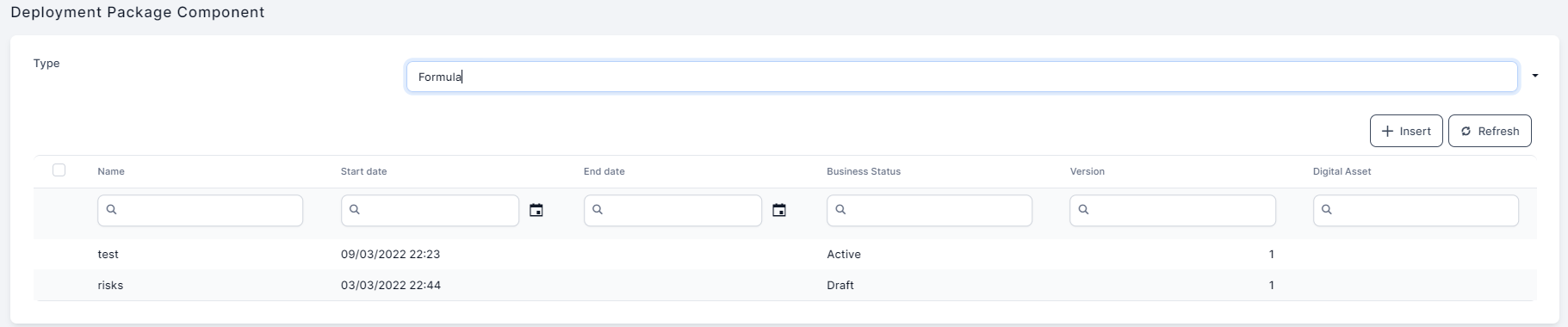
When exporting/importing a business rule from one environment to another via a digital solution package:
- Only the latest version of the rule is exported.
- Before exporting, each rule can be configured to be either activated (default) or imported as draft on the destination environment (for more information, see Define Business Rule Expressions).
- On import, the system compares the rule names, input parameters, and output steps on the destination environment with the ones in the package
- If all are identical with those on the import package, the system concludes the rule to be imported is an update to the one found on the environment, and the rule to be deployed becomes the latest version of the existing rule.IMPORTANT!
If the rule on the deployment environment is in a draft state, the system displays an error message on importing the package. The user must then remove or delete the draft version in order to deploy/import the rule from the package - If the rule name matches, but the input and output parameters are different from the package rule, the rule is imported as a new one with the name changed to
name_importdate. - If the name differs, a new rule is created with version no. 1.
- If all are identical with those on the import package, the system concludes the rule to be imported is an update to the one found on the environment, and the rule to be deployed becomes the latest version of the existing rule.
- The start date of the imported rules/data sets are set to the import date.
- The VersionStamp ID is updated when reexporting a package that received a change. For example, a package with a rule is exported from one environment with v22.1.10 and imported on another environment with v22.1.9.3. The package has a certain VersionStamp ID. When a change is made on v22.1.10 and the package is reimported on v22.1.9.3, the VersionStamp ID changes. This way, you can see that the package received a change before being reimported on the destination environment.