Premium Reimbursements
When an insurance policy or master policy is cancelled, any unused premium is returned as a premium refund. If the calculated refund amount is greater than zero, the system automatically creates a premium reimbursement request. This request is assigned Draft status if beneficiary details are incomplete, or Approved status when all required information is provided during the cancellation process.
During cancellation process, the system generates negative installments equal to the total refund amount. Compensation amounts greater than zero are represented as negative installments with OnTime status. The remaining refundable balance is recorded as a negative installment with StatementIssued status and is linked to the premium reimbursement record.
When the premium reimbursement status transitions to Paid (i.e., an outgoing payment is generated), the corresponding installment automatically updates from StatementIssued to Paid.
The Refund Approval Limits insurance parameter is used for defining how premium reimbursements are approved based on user roles and refund amounts. When useApprovalLimits is set to true, only users with specific roles can approve refunds, and the Approve button becomes active accordingly. Refunds up to 180 are auto-approved if all payment details are provided; otherwise, they remain in Draft status. Refunds above 180 always start as Draft and require manual approval by users whose role allows them to approve amounts exceeding the refund value. The roles and their approval limits are: Operations User (≤ 180), Operations Manager (≤ 2,000), and Operations SuperUser (up to 10 billion). If useApprovalLimits is false, any user with CRUD rights can approve without restriction.
During cancellation, the system creates a policy clone and cancels the related installments. If invoices have already been issued for those installments, the corresponding installments on the invoice are marked as Cancelled, and the invoice’s Unpaid Amount is reduced accordingly. If an invoice contains no remaining active installments, the invoice itself is cancelled.
When an invoice is only partially refundable, the cancellation process also reverses any associated payments.
To fill in payment details for the premium reimbursement, follow the steps below:
-
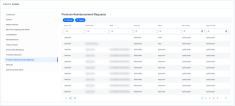
In FintechOS Portal, navigate to the main menu > Contract Management > Policies > Premium Reimbursement Requests.
-
Use the Policy No column or other filters to find the reimbursement request associated with your canceled policy or master policy. Double click to open the reimbursement request.
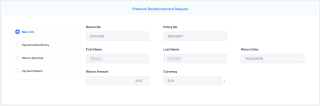
The Premium Reimbursement Request form opens after approving a cancellation that resulted in an amount to be refunded.
-
The Main Info section displays non-editable details about the policy.
-
The Payment Beneficiary section allows you to add a comment, and pick the Payment Method or Payment Beneficiary. Fill in the fields based on the type of payment:
 Bank Transfer
-
Payment Beneficiary: choose from Policy Beneficiary, Insured, Policy Holder, or Other Person. For the first three options, the data is automatically filled in. For the last option, you need to add:
-
Payment Beneficiary First Name;
-
Payment Beneficiary Last Name;
-
Payment Beneficiary PIN;
-
-
Bank: pick the bank from the list;
-
IBAN Account: type in the IBAN account.
Direct Debit UK
For Direct Debit UK, if the policy is paid with direct debit, then a valid mandate is in the system. Tick the checkbox Use current mandate to prefill the fields. Otherwise, fill the fields for Direct Debit UK:
-
Payment Beneficiary: choose between Contractant and Other person;
-
Account Holder: prepopulated with the First Name of the contractant;
-
Account Number;
-
Bank Sort Code.
Direct Debit SEPA
For Direct Debit SEPA, if the policy is paid with direct debit, then a valid mandate is in the system. Tick the checkbox Use current mandate to prefill the fields. Otherwise, fill the fields for Direct Debit SEPA:
-
Payment Beneficiary: choose between Contractant and Other person;
Payer first name: prepopulated with the First Name of the contractant;
-
Payer last name: prepopulated with the Last Name of the contractant;
-
Payer PIN/UTR: prepopulated with the PIN of the payment beneficiary;
-
IBAN;
-
Bank branch;
-
Amount type;
-
Amount;
-
Begin date;
-
End date.
Broker collection is not available, bank transfer or direct debit will be used for refunds.
Add a comment in the Payment Return Comments.
-
-
Click Propose Payment Return. The request transitions from the Draft status to Proposed.
-
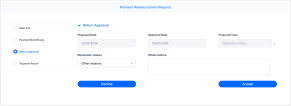
In the Return Approval tab, the following fields are shown:
-
Proposal Date: the day when the proposal for reimbursement was registered, usually today. This field is not editable.
-
Approval Date: the day when it was approved, usually today. This field is not editable.
-
Financial User: the user who made the proposal.
-
Resolution reason: pick from Wrong account, Closed account, Other reasons.
-
Observations: any comment regarding this operation.
-
-
Click Accept and the request transitions to Approved. Click Decline to cancel the request.
-
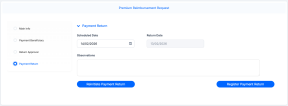
In the Payment Return tab, pick a Scheduled Date, check the Return Date and add an observation. Click Reinitiate Payment Return to restart the process and make changes, or click Register Payment Return to initiate the payment and transition the status to Paid.